
Crelate vs Recruiterflow: deep configuration or automation out of the box?

Feature by feature: staffing configurability, automation and AI, outreach sequences, and pricing. Where each platform pulls ahead for a recruitment agency in 2026, and where both leave a gap.

Or meet the third option built for recruiters: Jarvi.

silhouette
Crelate logo
RecruiterFlow logo

TL;DR

Positioning

Crelate fits staffing and recruiting firms that want a deeply configurable ATS and CRM built around placements, contractors and compliance, at an accessible entry price. Recruiterflow fits agencies that want automation, an AI assistant and recruiting sequences out of the box, in a clean interface that is quick to roll out.

Why it matters

Crelate publishes pricing from $85 (Essentials) to $119 (Business) with deep workflow configuration and staffing features, while Recruiterflow is a flat $119 with AIRA, visual workflow automation and native sequences included on the standard plan. The split is clear: Crelate is the configurable staffing system of record, Recruiterflow is the automation-and-outreach engine.

The catch

Where both stop: neither runs a true multichannel outbound sequence across email, LinkedIn and messaging at once, and neither reads a candidate reply to advance the pipeline on its own.

At a glance

CriterionCrelateRecruiterFlowEdge
Configurability & staffing fitDeep config, contractors, complianceStreamlined, opinionated workflowCrelate
Automation & AIAI on custom tiers, lighter automationAIRA and visual workflow automationRecruiterFlow
Outreach & sequencesEmail plus phone, SMS add-onNative email & SMS sequencesRecruiterFlow
Pricing & onboardingFrom $85, tiered, entry pointFlat $119, automation includedCrelate

Detailed technical comparison

Cross-analysis of tools: Sourcing, Data, and Pricing.

Comparison table: Crelate and RecruiterFlow (ATS & CRM features)
CrelateRecruiterFlow
Sourcing
1-click company importImport of companies with automatic data enrichment
1-click profile import via Chrome extensionA browser extension that adds a candidate to your ATS in one click, with their profile data
Professional Network SyncImport your professional network, with profile enrichment
External sourcing results importImport a sourcing project's pipeline, keeping its stages and metadata
External leads list importImport and sync prospect lists built outside the ATS
Legal data synchronization during importsSyncs company registration and legal identifiers (via Pappers or similar sources) during LinkedIn imports to maintain compliant, up-to-date client data
Email finder / contact discoveryFind verified email addresses for profiles on LinkedIn or other sites, allowing you to contact them directly
Automatic data completionAutomatically finds and adds missing data to profiles, such as a candidate's new job title, company logo, or company industry
AI & Automation
Outreach
ATS
CRM
Analytics
Integrations
Collaboration & UX
Data Security
Market proof
Support
Pricing
01

Crelate configures deeply around staffing, Recruiterflow keeps a streamlined agency workflow

CrelateRecruiterflowEdge: Crelate

How far a tool bends to your process, and whether it handles staffing back-office work, decides how long it stays your system of record. Crelate and Recruiterflow were shaped by different jobs.

Crelate

Crelate is built for staffing operations, with deep configurability of fields, workflows and layouts, native handling of contractors and temp placements, job-order and placement reporting, and compliance reporting (including EEO for US firms). A firm can tune it to its exact process and keep it as the system of record for years. That depth is the point for a staffing desk, at the cost of a heavier initial setup.

Recruiterflow

Recruiterflow is configurable around the agency recruiting workflow, with custom fields, pipelines and stages, but it is more opinionated and streamlined than Crelate: it is built for perm and contract agency placement rather than deep temp-staffing operations, with lighter contractor, timesheet and compliance handling. That focus is why it feels quick to adopt for a placement agency.

Verdict. Crelate wins for a staffing desk that needs configurable workflows, contractor handling and compliance reporting. Recruiterflow fits an agency that wants a clean, opinionated workflow without heavy configuration.
02

Recruiterflow ships AIRA and visual automation, Crelate keeps AI on higher tiers

CrelateRecruiterflowEdge: Recruiterflow

The automation and AI layer decides how much routine work the tool absorbs. Both invest here, but one includes it on the standard plan and the other reserves depth for higher tiers.

Crelate

Crelate offers keyword-based candidate scoring, resume summaries and an AI Assistant on its Business tier, with heavier agent and automation features reserved for its custom-priced Business Plus and Enterprise plans. The automation is capable but its deeper AI is gated behind quotes, so a small firm on Essentials or Business gets a lighter automation layer than the full platform suggests.

Recruiterflow

Recruiterflow includes AIRA, its AI assistant, for candidate scoring and job-description writing, plus visual no-code workflow automation and recruiting sequences on the standard $119 plan. Automations trigger on pipeline events to move candidates, send messages and update records, so a small agency gets meaningful automation from day one without a custom quote.

Verdict. Recruiterflow puts AIRA and visual automation in the standard plan, so a small agency gets more built-in from the start. Crelate's deeper AI is real but sits on custom-priced tiers. Neither advances the pipeline on a candidate reply.

03

Recruiterflow runs native recruiting sequences, Crelate texts through an add-on

CrelateRecruiterflowEdge: Recruiterflow

Outreach turns a sourced profile into a conversation, and how much of the cadence the platform runs decides how much a recruiter does by hand. This is where the two tools diverge most.

Crelate

Crelate centralizes email through two-way sync and phone, with SMS through a paid Crelate Messaging add-on and nurturing for talent pools. It has no native cross-channel sequence builder and no unified multichannel inbox, so outreach is email and phone with texting as a paid extra. For a placement-driven desk that engages known candidates, it covers the basics.

Recruiterflow

Recruiterflow has native recruiting sequences: multi-step, automated email and SMS cadences with follow-ups that stop when a candidate replies, plus bulk email and templates. They run over email and text rather than a true email-to-LinkedIn-to-messaging chain, but the cadence is built in and automated rather than an add-on, which suits an outbound agency desk.

Verdict. Recruiterflow gives an outbound desk more of the toolkit with native automated sequences included. Crelate keeps outreach around email and phone with SMS as an add-on. Neither runs a single sequence across email, LinkedIn and WhatsApp at once.

04

Crelate starts at $85, Recruiterflow is a flat $119 with more included

CrelateRecruiterflowEdge: Crelate

Price and what comes with it shape who each tool is for. Both publish their pricing, so the comparison is about the entry point and what the standard plan includes.

Crelate

Crelate publishes tiered pricing: $85 per user per month on Essentials and $119 on Business, with Business Plus and Enterprise on custom quotes, plus a free trial. The $85 entry point lets a small firm start cheaply and only move up for advanced AI and automation. The trade-off is that the fuller automation and AI live on the higher, custom-priced tiers.

Recruiterflow

Recruiterflow is a flat $119 per user per month on its Platform plan, with a free trial and Custom tiers above it for more AI agents and BI. There is no cheaper entry tier, but the standard plan already includes AIRA, visual automation and sequences, so the $119 buys a more complete feature set than Crelate's $119 Business tier does before its custom plans.

Verdict. For the lowest entry price, Crelate's $85 Essentials wins. For the most included at the standard price, Recruiterflow's $119 bundles automation and AI that Crelate reserves for custom tiers.

Pricing at a glance

per user / month, annual billing

CrelateRecruiterFlow
Entry$85 EssentialsATS, CRM, up to 2 users$119 PlatformATS, CRM, automation, AIRA, sequences, API
Growth$119 BusinessAI Assistant, analytics, portalsCustom AIRA planfull AI agent suite, advanced BI, onboarding
AdvancedCustom Business Plusadvanced AI, automation, full API
TopCustom Enterpriseagents, ISO / SOC2, priority support
AI includedAdvanced AI and agents on custom-priced tiersAIRA and automation on the standard plan; top agents on Custom

Which fits which team?

Neither tool wins outright. The right pick comes down to whether your value is configurable staffing operations or automation-first agency recruiting, and how much you want included on the standard plan.

Choose Crelate if:

  • You run a staffing or recruiting desk with contract and temp placements
  • You want deep configurability of fields, workflows and layouts
  • You need job-order, placement and compliance reporting
  • You want the lowest published entry price, from $85, with a free trial
  • You are fine keeping the deeper AI on higher tiers

Choose Recruiterflow if:

  • You run a perm or contract placement agency
  • You want AIRA, visual automation and sequences on the standard plan
  • You value a clean, opinionated workflow over heavy configuration
  • You want to be live quickly with automation from day one
  • A flat $119 with more included beats a cheaper, lighter entry tier

If neither profile fits cleanly, for example a team that wants exposed agentic AI, native multichannel sequences and EU data hosting at transparent pricing, it is worth widening the shortlist.

Jarvi: the third option that closes the gap Crelate and Recruiterflow leave open

Crelate keeps outreach around email and phone with its deeper AI on custom tiers; Recruiterflow automates email sequences but stays email-first. Neither runs multichannel sequences that read a candidate's reply and move the pipeline on their own.

Vs Crelate. Against Crelate, Jarvi puts its AI and outbound in the base product rather than on custom tiers: an interview and call notetaker, candidate scoring, and multichannel sequences, in an interface that is not English only.

Vs RecruiterFlow. Against Recruiterflow, Jarvi goes past email-first sequences. The same cadence runs across five channels at once, and an AI copilot suggests the next best action for each candidate instead of leaving the channel mix to the recruiter.

The Jarvi differentiator

The difference is AI reply detection with automatic pipeline movement. A candidate answers with interest, Jarvi stops the sequence and alerts the recruiter. They reply 'not now', Jarvi schedules a six-month recall. They decline, the record is archived cleanly with its notes. That capability, missing from both tools here, takes hours of manual follow-up off each recruiter every week.

See Jarvi in a guided demo

About Crelate

Crelate was founded in 2012 by Aaron Elder, previously the lead application architect on Microsoft Dynamics CRM and, before that, founder of a consultancy sold to Avanade in 2010. It is his fourth product. The company is US-based (Eagle, Idaho, after early years in the Seattle area) and focuses on the US staffing and recruiting market. Crelate raised a $1.2M seed, then a $5.3M Series A led by Five Elms Capital in 2019, and announced a further strategic growth investment from Five Elms in March 2022, for around $11.5M raised in total. It holds 4.5 on Capterra (about 440 reviews) and 4.4 on G2 (about 210 reviews), and reports serving more than 25,000 recruiting professionals. Its distinctive strength is deep configurability for US staffing workflows.

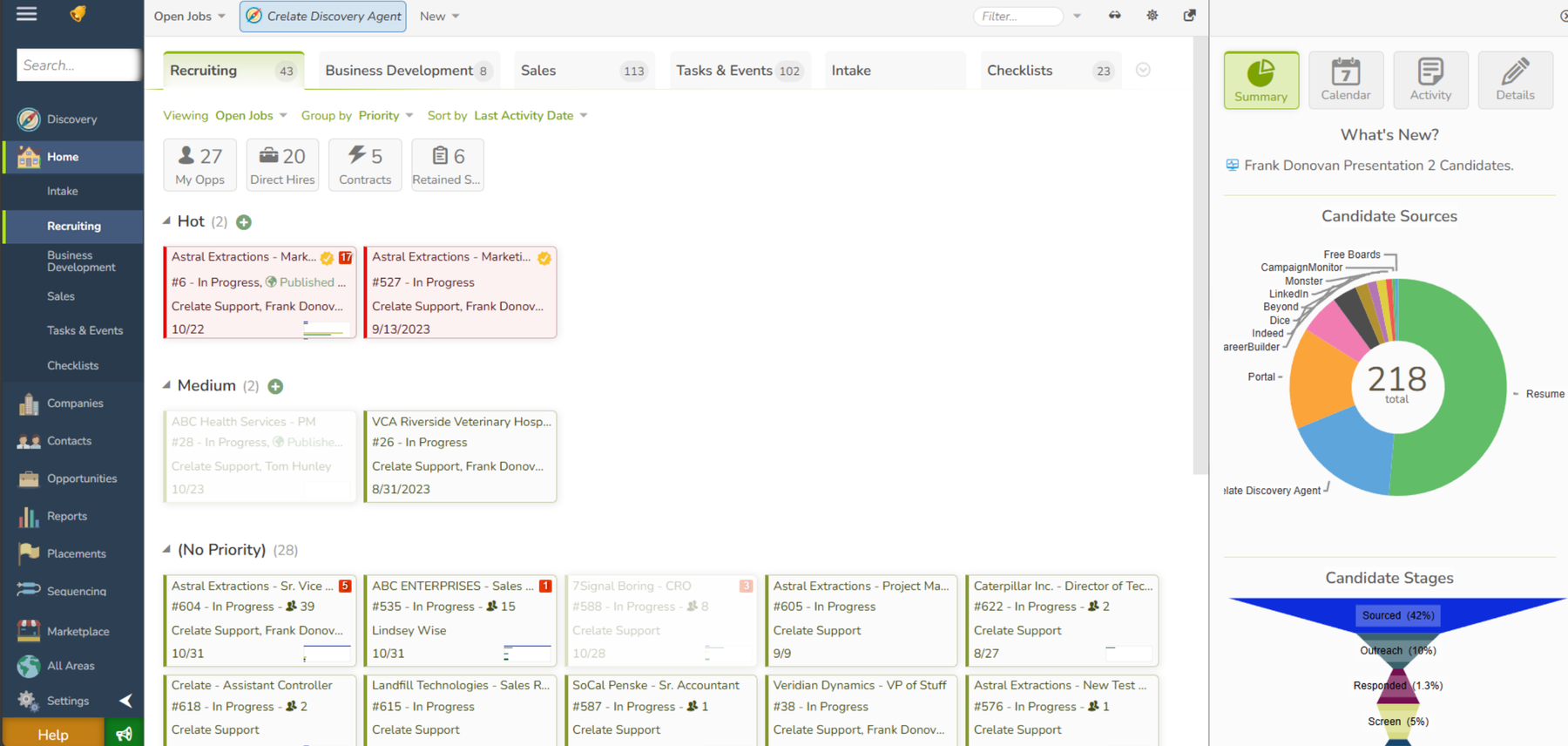
Crelate interface

About RecruiterFlow

Recruiterflow was founded in 2017 by Manan Shah, Naresh Shenoy and Amritanshu Anand, second-time founders and IIT alumni. It is built for small and mid-size staffing and recruiting agencies, and reports more than 2,100 firms running on it. The platform combines an ATS and CRM with an AI assistant (AIRA) for candidate scoring and job-description writing, visual workflow automation, recruiting sequences and a LinkedIn Chrome extension. Pricing is published at $119 per user per month with a free trial. It holds 4.6 on G2 (about 156 reviews) and 4.7 on Capterra, praised for its clean interface and quick onboarding. Its distinctive strength is a fast, agency-focused setup at transparent pricing.

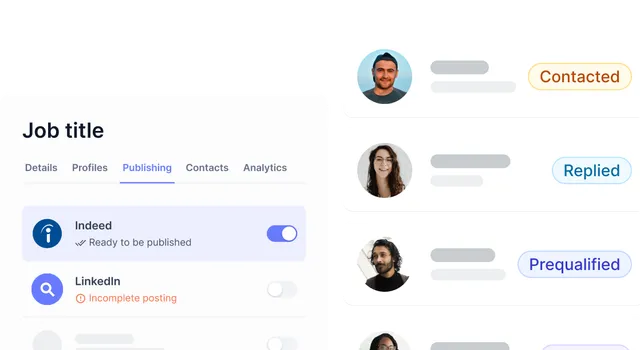
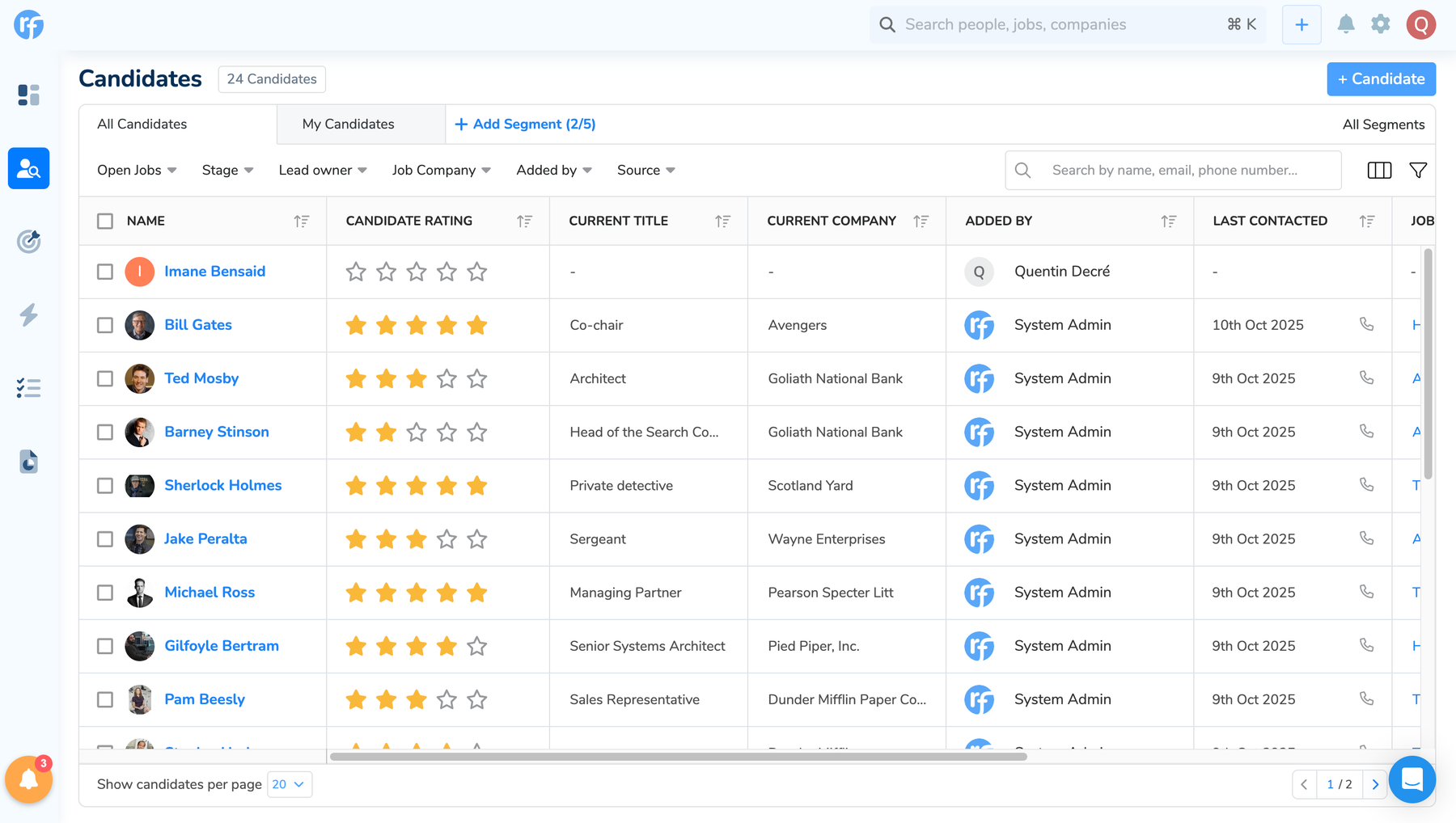
RecruiterFlow interface

FAQ: Crelate vs RecruiterFlow

This comparison guide analyzes the critical differences between Crelate and RecruiterFlow: pricing policy, free trial, customer support quality, and sourcing power. Use this data to choose the best-fit ATS for your agency.

Hero Image Mobile
alternative logo
logo

Ready to switch to Jarvi?

Join hundreds of agencies that made the switch to Jarvi. Book a demo to see how we can help you recruit better, faster, and more affordably.

Jarvi app screenshot

Crelate analyzed on December 3, 2025 • RecruiterFlow analyzed on November 17, 2025 — If you have any updates or corrections to share, please help us keep this article accurate and up-to-date via the chat in the bottom right corner.